Peter Fam is a Human Rights Lawyer in Sydney, Australia with experience in human rights, civil litigation and the not for profit sector. The original article can be found here: https://www.linkedin.com/pulse/curious-case-unlawful-public-health-orders-peter-fam (UPDATE 31/08/2022 new link which is not broken: https://crazzfiles.com/the-curious-case-of-the-unlawful-public-health-orders/)
I thought this was an excellently written article and it has been refreshing to finally see an increasing number of lawyers criticising recent government actions. However, there were a number of points which I thought were missed so I have written up my analysis in addition to the content of the original article.
First of all, in relation to the powers exercised by the Minister under section 7 of the Public Health Act 2010 (NSW), it states that the minister “may by order give such directions…”. Under section 5 “Definitions”, there are two types of orders which are defined – a prohibition order and a public health order. The former is defined by section 45 (which isn’t relevant in this situation) and the latter by section 62.
In section 62 of the Public Health Act 2010 (NSW), the provisions for issuing a public health order are similar to those found in the Biosecurity Act 2015 (Cth) – namely, that they must name the person, prove that they are suffering from a disease etc. From my reading, I have not found any other provision in the Act for the issuing of public health orders, other than those in section 62. Therefore, I would argue that the Public Health Act 2010 (NSW) is not inconsistent with the Biosecurity Act 2015 (Cth) on the basis that was claimed in the article. And since the Public Health Act 2010 (NSW) does not actually give the Health Minister or department as broad powers as those being exercised, I would say that the issue is that they are just acting beyond any power provided for by legislation. Read section 62 here: https://legislation.nsw.gov.au/view/whole/html/inforce/current/act-2010-127#sec.62.
Secondly, in addition to the section 109 (inconsistency between state and federal laws) argument, there is also the issue of federal laws being inconsistent with the Constitution. Section 51, sub-section 23a of the Commonwealth Constitution allows the Parliament to make laws, subject to the Constitution, with respect to: medical and dental services (but not so as to authorise any form of civil conscription).
This section has been interpreted by the High Court to mean that there can be no compulsion on a patient to accept any medical services/procedures, or on a doctor to provide any medical services or procedures (see: Wong v Commonwealth [2009] HCA 3, General Practitioners Society v Commonwealth [1980] HCA 30 and British Medical Association v Commonwealth [1949] HCA 44). Therefore, even if there is a section of the Biosecurity Act 2015 (Cth) (or any other legislation) which requires someone to do something like receive a vaccination (eg. section 92 or 478), I would argue that because it is inconsistent with section 51xxiiiA of the Constitution – and since all laws can only be made subject to the Constitution – it is consequently invalid.
Thirdly, the reason why I think Clive Palmer’s court challenge had failed is because they were arguing the validity of the direction under the state Act and not the validity of the Act itself. This means there was no constitutional argument on whether the Act infringed section 92 of the Constitution. Here is a part of Clive Palmer’s case transcript:
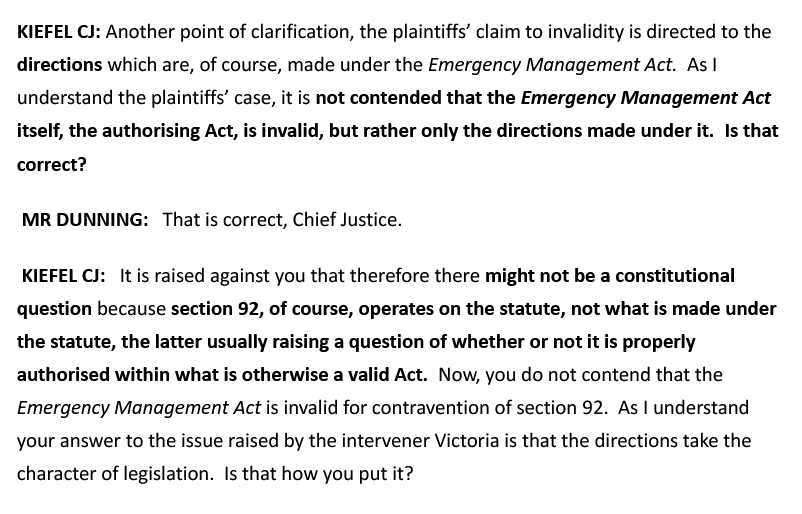
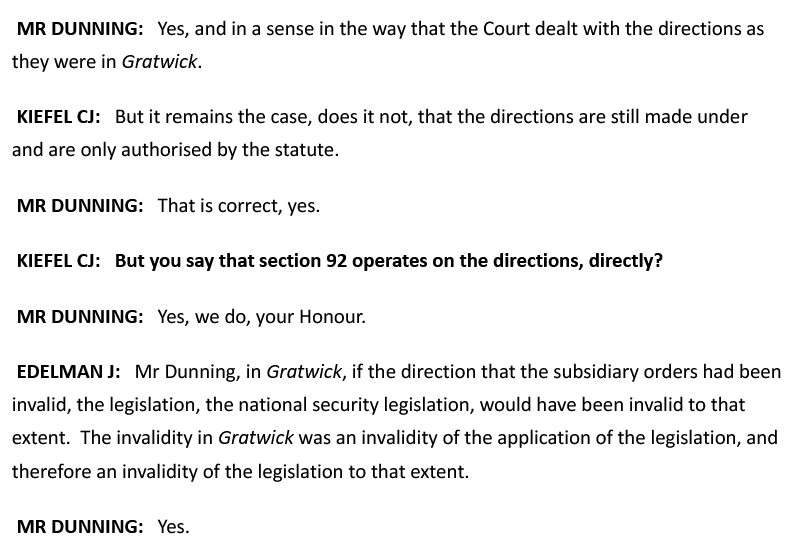
Furthermore, it has already been ruled by the High Court in Gratwick v Johnson [1945] HCA 3 (among other cases) that “the people of Australia are thus free to pass to and fro among the States without burden, hindrance or restriction.” In my opinion, Clive’s case was challenging the ministerial action made under statute, not the legislative power of the statute itself, and that was why the case failed. It is my understanding that section 92 – and other constitutional guarantees – are a restriction on legislative power only and not ministerial action.
Lastly, all the public health order by Brad Hazzard have been made under section 7, titled “Power to deal with public health risks generally”. However, it is section 8 that is titled “Power to deal with public health risks during state of emergency“. All the purported powers being exercised by the Health Minister seem to have been gazetted under the wrong section, which would be in line with what Serene Teffaha has argued.
These are some of my thoughts in addition to what was written in Peter’s article. I welcome any feedback and additional information that anyone would like to send.
 Digging Apart Reality
You must be logged in to post a comment.