What good is a “voice” if there aren’t any ears to listen to it? And can a single “voice” speak on behalf of 100s of different Aboriginal tribes and nations?
These were the instructions from King George III to Captain Cook, regarding the First Fleet’s treatment of the Natives:
The proposed section 129 of the Commonwealth Constitution:
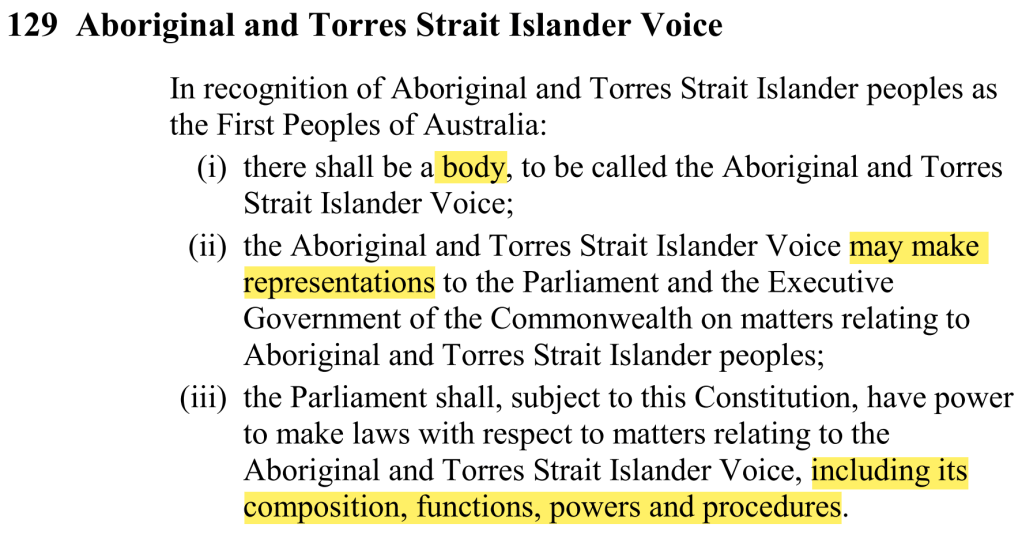
What does “body” mean in s. 129(i)?
Is it a charity? An incorporated or unincorporated entity? A corporation sole or corporation aggregate?
Theoretically, “The Voice” could be a single person or a conglomerate of mining companies. No further specificity is articulated in this proposed amendment to the Constitution.
What does “make representations” mean? Cambridge Dictionary defines it as follows:
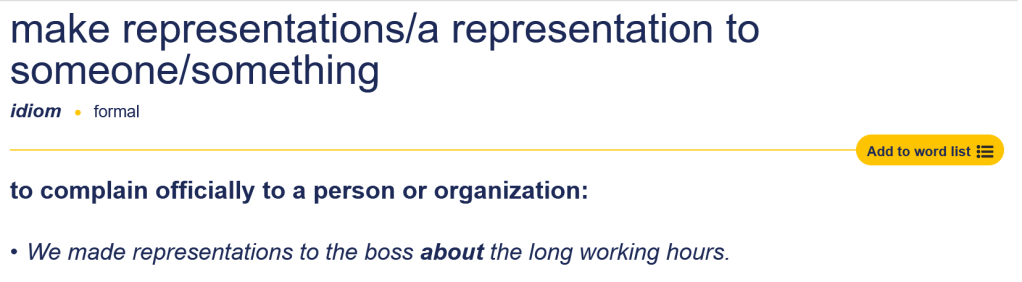
So s. 129(ii) simply confers the ability on this “body” to complain officially to the Executive or Parliament. This is something that any individual or corporation can already do and already happens. Anyone can complain or “make representations” to the Parliament or various government agencies.
In 129(iii), we see that it is the Parliament that decides what composes of this “body” and the functions and powers that this “body” can exercise. It does not grant First Nations or Aboriginal or Torres Strait Islander people this ability. Only the Parliament decides what constitutes “The Voice”.
So this undefined “body” (controlled by the Parliament) could be just about anything. Or anything could be this “body”.
To be “sovereign” means to be the master of ones own affairs. If Indigenous sovereignty “was never ceded”, what happens when a “body” (allegedly representing them) was ultimately controlled by the Parliament?
As the Quadrant Magazine writes in this article:
“Section 129 doesn’t set any requirements for the Voice. It doesn’t require the Voice to be independent. It doesn’t require the Voice to be representative of Aborigines and Torres Strait Islanders. It doesn’t require the Voice to have any Aboriginal or Torres Strait Islander members. It doesn’t require the members to be elected by Aborigines or Torres Strait Islanders. In fact, it doesn’t even require the members to be elected.
The Voice need not even be a corporate body. It could be an unincorporated body, such as the Agriculture Consultative Committee (established by the Australian Competition and Consumer Commission)—just a mob sitting around a table (or, no doubt these days, meeting on Teams). It could be a corporation sole—a body corporate that consists of one member only, who could be an Eskimo, appointed by the minister. It could be composed entirely of assimilationists—One Nation, rather than First Nations. The legislation could exclude from membership anyone born in Borroloola, or could give the minister—or anyone else, for that matter—the power to disqualify any candidate on any ground.”
 Digging Apart Reality
You must be logged in to post a comment.